

An actuarial report prepared for litigation has a purpose beyond producing a number.
It must translate the available evidence into a financial assessment that is reasonable, explainable and capable of withstanding scrutiny.
In our recent article, The Report Factory Myth, we explored why actuarial reports should never become exercises in applying standard assumptions to different claimants. Every claimant has different circumstances, different evidence and different uncertainties.
Our article RAF Contingencies: The Percentage Is Not the Point made a similar point about contingencies: the percentage itself is not the answer – the reasoning behind it is.
The courtroom is where those principles are tested.
The Court Is No Longer a Passive Recipient
One of the more noticeable developments in RAF litigation in recent times is the increasingly active role courts are taking in interrogating quantum.
Judges are not simply accepting actuarial calculations at face value, just because they are unopposed. Instead, they are questioning contingency deductions, preferring one projection over another and requiring counsel to justify the assumptions underpinning the calculation.
For attorneys and advocates appearing in default judgment matters, this has become a familiar experience.
A matter can arrive in court with a completed actuarial report, only for the court to indicate that a different contingency should apply, that a postulation requires reconsideration, or that the calculation should be revised to reflect the court’s preferred approach before an order is granted.
The number is no longer the end of the conversation.
In many matters, it is the beginning.
When Assumptions Change, Quantum Changes
The reason this matters is simple.
Small changes in actuarial assumptions can produce substantial changes in quantum.
A five-percent adjustment to a contingency, for example, can move a claim by hundreds of thousands of Rand.
A different interpretation of residual earning capacity can alter an entire future earnings projection.
A revised retirement assumption can change the capitalised value of the loss entirely.
That is why actuarial assumptions cannot exist in isolation from the evidence – nor from the evolving approach of the courts.
Recent Judgments Reflect the Trend
Recent RAF judgments illustrate how actively courts are exercising their discretion over actuarial quantum.
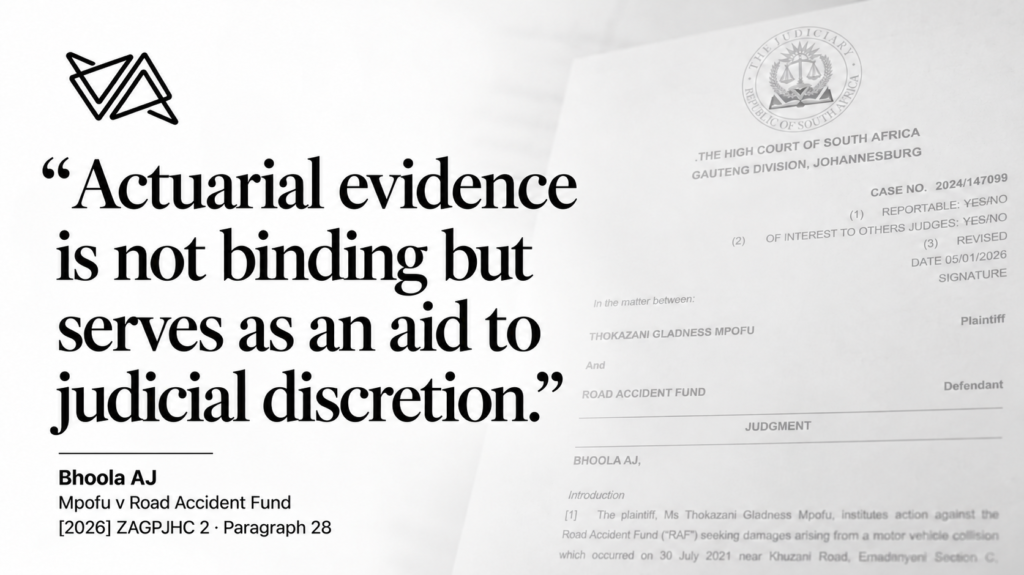
In Mpofu v Road Accident Fund, the court rejected the higher actuarial projection presented by counsel, preferred the more conservative calculation and awarded a lower amount after considering the claimant’s ongoing employment and residual earning capacity. The court reaffirmed that actuarial evidence is an important aid, but it does not bind the court.
In Mogale v Road Accident Fund, the court accepted most of the actuarial calculation but changed the future contingency deduction, finding that a 20% contingency better reflected the claimant’s circumstances.
Similarly, in Tlatsana v Road Accident Fund, the court rejected a 35% post-morbid contingency and substituted a 20% deduction, holding that the evidence did not justify the higher contingency.
These judgments are not simply about percentages.
A Different Outcome
Against that backdrop, a recent RAF matter involving Vector Actuaries provides a useful contrast.
The matter proceeded to default judgment with loss of earnings supported by medico-legal and actuarial evidence.
The court ordered the RAF to pay 100% of the claimant’s proven or agreed damages, including the full quantified amount of R1,595,800 for future loss of income. The order also records Vector Actuaries as the actuaries involved in the matter.
The significance of the outcome is not simply the amount awarded.
It is that the actuarial quantification formed part of the evidence before the court and ultimately stood as the quantified future loss included in the order.
The Difference Is Preparation
We do not believe the lesson is that every report should produce the same outcome.
Every claimant’s circumstances are different.
Every matter presents different evidence.
Every court retains its discretion.
The lesson is that actuarial reports should be prepared with judicial scrutiny in mind from the outset.
That means ensuring assumptions are supported by the available evidence.
It means testing whether a contingency reflects the uncertainty that actually remains.
It means considering whether developments in case law affect the approach being adopted.
And it means recognising that even a single sentence in an Industrial Psychologist’s report can alter the financial outcome if it is interpreted differently.
Where ambiguity exists, assumptions should be confirmed, not assumed.

Built for the Conversation That Comes Next
Perhaps the biggest change in RAF litigation is that actuarial reports increasingly become part of an ongoing conversation rather than the final word.
Counsel may need to explain them.
Judges may question them.
Assumptions may need to be defended.
And occasionally, postulations may need to be revisited before an order is granted.
That reality reinforces the principle we explored in The Report Factory Myth: a report should not simply apply familiar assumptions because they have been used before.
It should be prepared on the understanding that every assumption may eventually need to answer a simple question:
Why this assumption?
When that question comes from the bench, the strength of an actuarial report lies not only in the number it produces, but in the reasoning that supports it.
Because when an actuarial report reaches court, it is no longer just a calculation.
It becomes evidence.