

The Road Accident Fund (“RAF”) plays an important role in South Africa’s social-compensation framework. Established under the Road Accident Fund Act 56 of 1996, the Fund provides compensation to persons who suffer loss or damage because of bodily injuries caused by the negligent driving of motor vehicles.
For many claimants, therefore, an RAF claim is much more than an abstract piece of civil litigation. It may represent the financial support for medical treatment, future care, loss of earnings or earning capacity, and compensation for the broader consequences of serious bodily injury.
In short, for many road-accident victims in South Africa, a RAF claim may be the most significant financial asset they ever own.
So, when a RAF matter progresses without unnecessary delays from the RAF, its attorneys, the claimant’s representatives, experts or the court administration, the South African judicial procedure can develop substantial procedural momentum. Each properly completed step prepares the matter for the next.
The result is a litigation process that is more predictable, economical and effective, and which better serves both the individual claimant and the administration of justice.
Procedural Momentum in a RAF Matter
A Road Accident Fund claim ordinarily begins outside the courtroom. The claimant’s attorney must establish the circumstances of the collision, identify the injuries and losses sustained, and submit the relevant claim documentation to the RAF. Depending on the nature of the claim, relevant medical, employment and financial information must also be obtained. Where the matter cannot be resolved administratively, litigation may follow.
Once summons has been issued, the matter enters the formal civil-litigation process. Pleadings define the issues between the parties. Discovery enables the parties to obtain the relevant documentary evidence. Expert examinations and reports assist in determining the medical consequences of the accident and, where applicable, the claimant’s earning capacity and future needs. Pre-trial procedures then narrow the disputes that genuinely require adjudication.
These stages of procedural formalities are intended to move the dispute progressively towards resolution.
How a RAF claim gains momentum
Compare how cooperation moves a claim forward and how avoidable delays create extra work.
Illustrative litigated claim. Stages can overlap, and settlement can occur earlier.
-
Investigate & lodge
Claim documentation1Establish the collision, injuries and losses.
Repeated follow-ups -
Define the dispute
Pleadings2Clarify what is claimed and what is contested.
Procedural follow-ups -
Prepare the evidence
Discovery & experts3Exchange records; assess and quantify relevant losses.
Applications to compel -
Narrow the issues
Pre-trial, mediation & case management4Record agreements; identify the genuine disputes.
Renewed preparation -
Resolve the claim
Settlement or judgment5Negotiate on the evidence; take remaining disputes to court.
Further hearings -
Comply & finalise
Payment, costs & any undertaking6Pay the award, resolve costs and issue any agreed undertaking.
Enforcement proceedings
Preparation supports progress at every stage
Claimant: earlier certainty · RAF: fewer avoidable costs · Courts: better use of hearing time
Schematic, not a timetable. Future care under an undertaking may continue after the main claim is resolved.
Judicial Case Management
This principle is particularly evident in judicial case management.
For example, The Gauteng High Court’s case-management framework expressly places primary responsibility on litigants and their legal representatives to prepare matters properly, comply with the Rules and applicable directives, and advance cases towards adjudication. The stated purpose of judicial case management includes alleviating congested trial rolls and addressing causes of delay in finalising cases.
Accordingly, an efficiently managed RAF case develops momentum because uncertainty is progressively removed. The merits of the collision can be investigated and, where appropriate, conceded. Medico Legal evidence can establish the nature and consequences of the injuries. Industrial psychologists, occupational therapists and other experts can identify the claimant’s functional and vocational limitations. Actuarial evidence can quantify past and future financial losses. Pre-trial discussions can identify which issues are common cause and which remain genuinely disputed.
Where the RAF and its attorneys respond timeously throughout this process, there is substantially less need for interlocutory applications compelling compliance, postponements, supplementary preparation or emergency attempts to resolve issues immediately before trial.
The importance of this cooperation is demonstrated by the very existence of specialised RAF procedures within the courts. Gauteng practice directives have specifically provided mechanisms to deal with failures by defendants, particularly the RAF, to engage constructively. For example, the Gauteng case-management framework provides for a Trials Interlocutory Court through which a plaintiff can seek orders compelling compliance where a defendant defaults on procedural obligations. The fact that such mechanisms are necessary demonstrates the disruption that non-compliance can cause. Conversely, where compliance occurs voluntarily and promptly, these additional procedural steps are unnecessary.
Earlier Identification and Resolution of the Real Dispute
One of the principal advantages of an efficiently conducted RAF matter is that the true issues in dispute can be identified much earlier.
Not every RAF claim requires every conceivable issue to proceed to a contested trial. Liability may be conceded while quantum remains disputed. Certain heads of damages may become common cause after expert reports are exchanged. An undertaking for qualifying future medical expenses may be appropriate, while loss of earnings or general damages may require further consideration.
Early engagement allows the parties to distinguish between matters requiring judicial determination and matters capable of agreement.
This has substantial practical value. A court should ultimately be required to determine genuine disputes, rather than issues that remain unresolved merely because the parties did not investigate or discuss them in time.
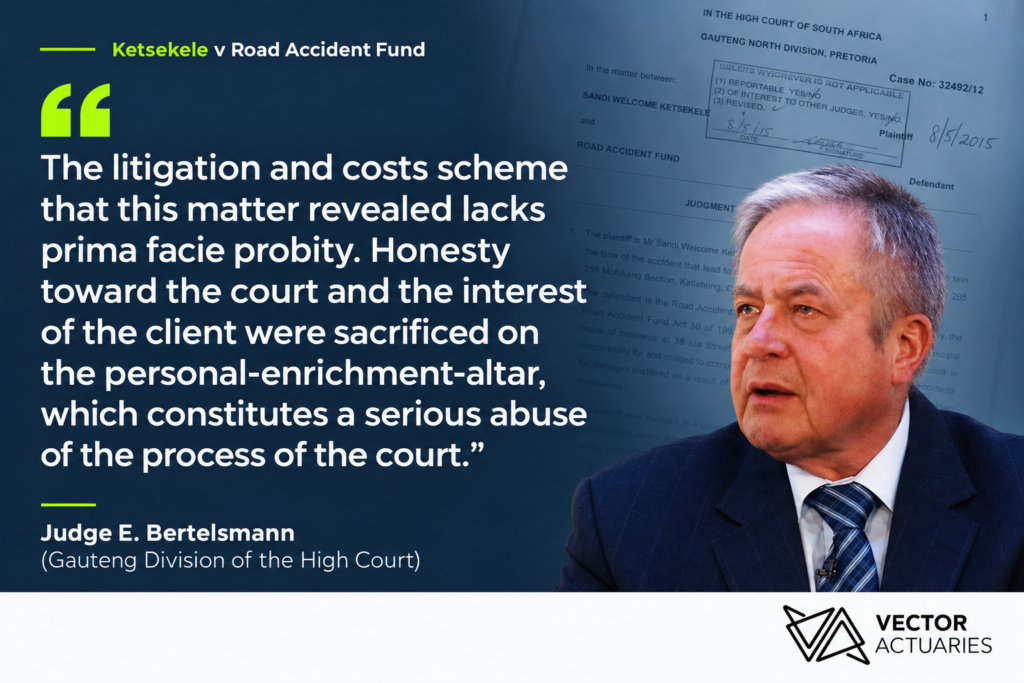
The courts have long criticised situations in which RAF matters are inadequately investigated and only meaningfully considered shortly before trial. In Ketsekele v Road Accident Fund, the Gauteng High Court described the damaging consequences of claims being left unresolved for years where they could have been investigated and negotiated substantially earlier and at considerably lower cost.
Where both sides instead engage throughout the process, the litigation develops continuously rather than remaining dormant until the trial date approaches.
Benefits to the Injured Claimant
The most immediate beneficiary of an efficient process is, of course, the claimant.
A claimant who has suffered serious bodily injuries may experience reduced earning capacity, unemployment, medical expenses and a need for future treatment or assistance. Delay in resolving the claim may therefore have consequences extending considerably beyond the inconvenience ordinarily associated with civil litigation.
Earlier finalisation provides financial certainty. If compensation for loss of earnings is established, the claimant receives access to the funds intended to compensate for the financial consequences of the accident. If a section 17(4)(a) undertaking forms part of the outcome, qualifying future medical and related expenses can be dealt with in accordance with the undertaking.
Efficient litigation also reduces the emotional and administrative burden placed on claimants and their families. Repeated consultations, postponed court appearances, duplicated expert work and prolonged uncertainty can all increase the strain associated with an already serious injury. A matter that progresses according to predictable procedural milestones gives the claimant a clearer path towards finality.
Finally, there is an evidential advantage. The closer investigations, expert examinations and witness consultations occur to the relevant events, the lower the risk that evidence becomes difficult to obtain, witnesses become unavailable or memories deteriorate.
Reduction of Unnecessary Legal Costs
Proper procedural momentum also reduces litigation costs.
Delay seldom occurs without financial consequences. A postponed trial may lead to additional consultations with attorneys and counsel, renewed preparation, expert reservation fees and further administrative costs. Failure to make discovery or respond to procedural notices may require interlocutory applications. Failure to deal with an issue at the proper stage may result in supplementary reports or further court proceedings.
These costs ultimately burden the claimant, the RAF, and the public purse.
South African courts have expressly recognised the relationship between procedural delay and unnecessary cost. In a 2026 Free State High Court matter, the court observed that the underlying RAF actions could potentially have been finalised earlier through effective case management rather than belated interlocutory proceedings and emphasised that case management can be used to obtain orders directed towards trial readiness.
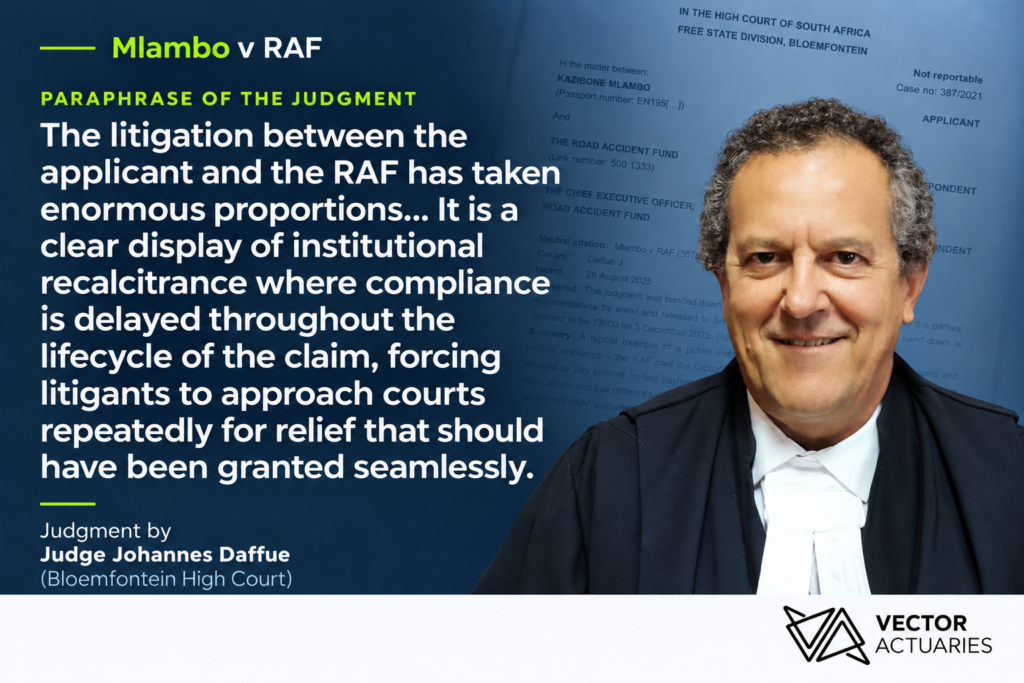
Similarly, litigation concerning delayed compliance after judgment demonstrates how disputes can continue even after the principal compensation issue has effectively been determined. In Mlambo v RAF, the Free State High Court described litigation involving multiple applications concerning payment, interest and costs after the capital claim had already been awarded. Such proceedings illustrate the economic importance of prompt compliance not merely before trial, but throughout the entire lifecycle of an RAF claim.
Efficient conduct therefore produces a compounding benefit: every procedural issue dealt with correctly at the appropriate stage removes the possibility that additional legal work will later be required to correct it.
Benefits to the RAF and the Public Purse
Efficient litigation should not be regarded as benefiting claimants at the expense of the RAF. In many respects, it benefits the Fund equally.
Early investigation enables the RAF to identify weak, overstated or unsupported components of a claim before unnecessary litigation expenses are incurred. At the same time, legitimate components can be admitted or settled without the costs associated with preparing an issue for trial.
The RAF is a statutory institution administering a public compensation scheme. Avoidable legal expenses therefore have broader consequences than an ordinary dispute between two private litigants. Resources devoted to unnecessary interlocutory proceedings, repeated court appearances or last-minute preparation cannot simultaneously be used for the efficient investigation and settlement of other claims.
Prompt decision-making consequently assists the RAF in controlling litigation costs, improving the predictability of its liabilities and allocating its resources more effectively.
It also enables RAF attorneys to perform their function more effectively. Where instructions are available, claims have been properly investigated and authority to negotiate is obtained sufficiently early, the attorneys appearing for the RAF can engage meaningfully with their opponents and the court instead of arriving at trial without the institutional instructions necessary to resolve matters.
Benefits to the Courts and the Wider Justice System
The benefits extend beyond individual RAF matters.
South African High Courts operate with limited judicial time and substantial civil caseloads. Every unnecessary RAF interlocutory application, postponement or unnecessarily contested trial occupies a court slot that could have been used to determine another matter.
Efficient case preparation therefore has a systemic benefit.
The Gauteng High Court has increasingly used judicial case management, specialised RAF default-judgment procedures and interlocutory mechanisms to manage the large volume of these matters. As recently as 2026, the Gauteng Division continued to issue dedicated directives and court rolls dealing specifically with RAF defaults and special interlocutory proceedings.
Recent court-management initiatives also demonstrate the practical effect that focused procedural management can have on court lead-times. A 2025 Johannesburg High Court workflow report referred specifically to a special RAF Default Judgment Court intended to provide rapid access to judgment and recorded significant reductions in lead times in certain other categories of proceedings following active court-management interventions.
The underlying principle is straightforward: court capacity is used most efficiently when matters arriving before judges are genuinely ready to be decided.
If RAF matters are investigated early, experts are instructed in time, disputes are properly narrowed and settlements are concluded before unnecessary trial preparation takes place, fewer judicial resources are consumed. Judges can concentrate on disputes requiring adjudication instead of managing procedural failures.
The Importance of Proper, Rather Than Merely Fast, Resolution
Speed should nevertheless not become the sole objective.
An efficient RAF system is not one in which claims are finalised as rapidly as possible irrespective of accuracy. The objective should instead be timely and procedurally sound finalisation.
The courts retain an important supervisory role, particularly where settlement agreements are sought to be made orders of court. The Constitutional Court’s decision in Mafisa v Road Accident Fund confirms the significance of proper judicial procedure when RAF settlements are presented to a court.
More recently, the Gauteng High Court has cautioned against inappropriate piecemeal settlements that may fragment litigation, duplicate evidence or circumvent the proper procedure for separating issues.
Accordingly, momentum must arise from proper preparation and cooperation, rather than from shortcuts.
A claim that is investigated comprehensively, supported by appropriate evidence and narrowed systematically can move quickly while still protecting the interests of both parties. This represents true procedural efficiency.
Conclusion
Where unnecessary delays are absent, the judicial procedure governing RAF litigation can operate as a progressive system in which each completed stage generates momentum towards final resolution.
- Early investigation informs the pleadings
- Proper discovery identifies the evidence
- Expert reports quantify the consequences of the injuries
- Pre-trial engagement narrows the disputes
- Case management ensures trial readiness, and
- Informed negotiation creates opportunities for settlement before scarce judicial resources are required.
The benefits are substantial.
Claimants obtain compensation and certainty sooner. The RAF avoids unnecessary legal expenditure and gains earlier visibility of its legitimate liabilities. Attorneys can focus on genuine disputes rather than procedural enforcement. Experts are used more efficiently. Courts encounter matters that are properly prepared and genuinely require adjudication. Ultimately, fewer cases occupy court rolls unnecessarily and public resources are used more effectively.
The efficiency of RAF litigation is therefore not determined solely by how quickly a trial date can be obtained. It depends upon continuous procedural momentum from the beginning of the claim until payment and finalisation.
When the RAF, its attorneys, claimants’ representatives and the courts fulfil their respective functions promptly and professionally, the existing judicial process has the capacity to resolve claims substantially more efficiently. In that environment, procedural compliance is not merely administrative: it becomes one of the principal mechanisms through which access to justice is translated into a practical and timely remedy.