

Templates create consistency. Established processes create efficiency. Familiar assumptions make reports easier to produce and review.
But when every claimant’s report begins to look the same, and the same assumptions are carried from one matter to the next without consideration of the individual circumstances, the actuarial report risks becoming a product of a process rather than an assessment of an individual claimant’s circumstances.
That is the report factory myth.
The idea that an actuarial report can be produced by following a sufficiently refined template, with the claimant’s information simply inserted into predetermined assumptions, overlooks what makes actuarial work valuable in litigation.
Every Claimant Is Different
Every loss of earnings matter starts with an individual.
An individual employment history, education history and career trajectory. An individual set of injuries. An individual set of expert opinions about what that person’s future may have looked like, but for and having regard to the accident.
Two claimants of the same age, with the same occupation and even similar injuries, may have completely different loss-of-earnings profiles.
One may have significant post-morbid earning capacity while another may be completely unemployable. One may have demonstrated consistent career progression before the accident, while another may have had an uncertain employment history or been approaching retirement.
These differences matter.
The calculation must therefore reflect the evidence of that claimant.
Illustrative case study
Same on paper.
Different in evidence.
Two claimants share the same headline facts. The evidence beneath those facts produces two very different loss-of-earnings models.
What looks the same
Claimant A
Meaningful residual capacity- Work history
- 12 stable years; two promotions
- Education
- Diploma and strong performance record
- Career path
- Probable progression to office manager
- After accident
- Returned in an accommodated role
- Expert view
- Capable of supported sedentary work
Claimant B
Effectively unemployable- Work history
- Intermittent; only 18 months in the role
- Education
- Grade 12; no further qualification
- Career path
- Inflationary growth only
- After accident
- Persistent pain and cognitive fatigue
- Expert view
- Unable to sustain work in the open labour market
Similar age, job, salary and injuries do not create the same claim. Employment history, career evidence, functional outcome and expert opinion change the model.
Evidence profile
Claimant A: a reduced career
- A long, stable employment record supports a stronger pre-accident career trajectory.
- Past promotions and a diploma support progression to office manager.
- The claimant returned to an accommodated position and retains meaningful earning capacity.
- Future growth is constrained, but employment remains sustainable with support.
Illustrative modelling outcome
Career interrupted, not eliminated
Evidence profile
Claimant B: earning capacity lost
- A fragmented employment record supports a more conservative pre-accident trajectory.
- No evidence supports progression beyond inflationary increases.
- Persistent cognitive fatigue and pain prevent reliable attendance and productivity.
- The experts consider the claimant effectively unemployable in the open labour market.
Illustrative modelling outcome
Lower trajectory, greater loss
Illustrative example only. Capital values are rounded and assume that appropriate contingencies have already been applied; they are not a valuation of an actual claimant.
The difference is not in the template. It is in the evidence.
Assumptions Must Have a Foundation
An assumption used in an actuarial report should have a reason for being there.
Where an assumption has a legal or evidential foundation, that foundation should be understood and, where appropriate, reflected in the report.
Even a single sentence in an Industrial Psychologist’s report can have more than one interpretation, and those interpretations can lead to very different actuarial outcomes. Where the wording is unclear, the actuary should not simply choose an interpretation and proceed. The intended meaning should be confirmed by the expert before finalising the calculation.
The objective is to ensure that the assumptions used are appropriate to the circumstances of the individual claimant and can be properly explained.
An actuarial report prepared for litigation is not simply a calculation delivered to an attorney.
It may become evidence. It may be challenged by another expert or interrogated during settlement negotiations. Ultimately, the assumptions and calculations are considered by a judge and form the evidence considered by the court.
The actuary should therefore be able to stand behind the methodology and explain the reasoning that produced the number.
That requires an understanding not only of the mathematics, but also of the legal and evidential environment in which the calculation will be used.
Case Law Matters
The courts have developed principles governing the assessment of damages, including the treatment of contingencies and the extent to which actuarial calculations assist the court.
An actuarial calculation provides a mathematical assessment of the financial consequences of a particular set of assumptions. Ultimately, however, the court determines what is fair and reasonable.
That makes the relationship between actuarial methodology and case law important.
A report should not merely state an assumption. Where appropriate, it should be possible to understand why that assumption is defensible within the legal framework of the claim.
This is particularly important where an assumption may materially affect quantum.
If an assumption can move the value of a claim by hundreds of thousands (or millions) of Rands, it deserves more than a default setting.
It deserves consideration.
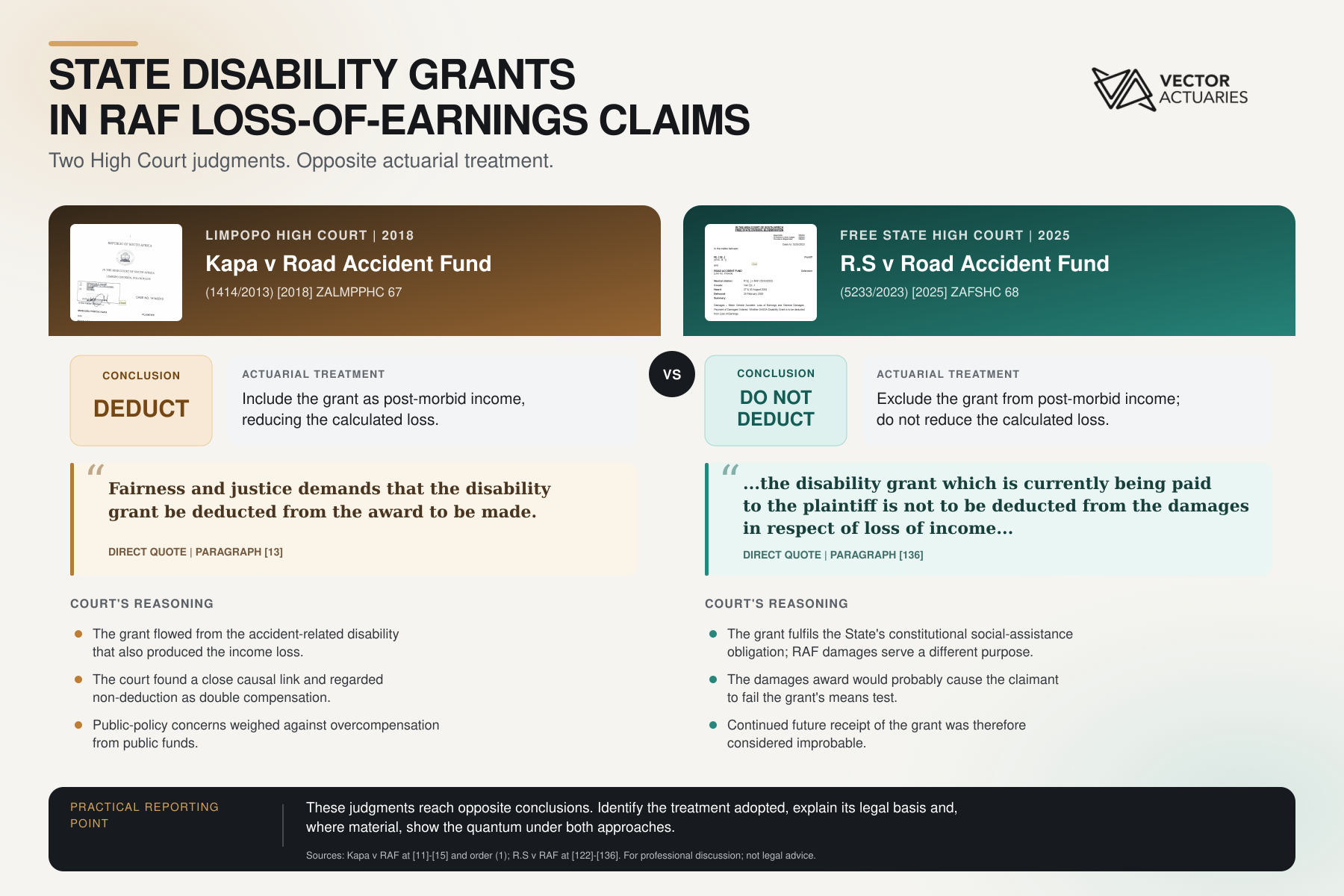
For example, the treatment of state disability grants is an area where the courts have reached different conclusions. In Kapa v Road Accident Fund (1414/2013) [2018] ZALMPPHC 67, the court held that the grant should be included in post-morbid income, while R.S v Road Accident Fund (5233/2023) [2025] ZAFSHC 68 reached the opposite conclusion and excluded it. With no authoritative ruling settling the issue, the treatment of the grant remains an important actuarial consideration. This illustrates why assumptions cannot simply be carried from one report to another. Keeping ahead of current case law is essential to ensuring that the assumptions used in an actuarial report are current, considered and defensible.
The Difference Is in the Thinking
A template can tell you what information to include, but it cannot determine whether the information supports the assumption.
A standard calculation can tell you what the result is, but it cannot determine whether the model reflects the reality of the claimant’s circumstances.
A familiar contingency can tell you what percentage has often been used, but it cannot tell you whether that percentage appropriately reflects the uncertainty in a particular claimant’s career.
That is where actuarial judgement matters.
The value is in understanding how the number was produced and being able to defend it.
Built to Withstand Scrutiny
We continually assess the assumptions used in our actuarial reports against the available evidence, relevant case law and developments in actuarial practice.
Where the circumstances of the claimant justify a change in a commonly used assumption, that change should be considered and supported.
And where an assumption materially affects the quantum, its impact should be understood.
The ultimate objective is not simply to arrive at a figure. It is to arrive at a figure that can withstand scrutiny.
An actuarial report should never be just another report coming off a production line. It should be an assessment of the individual loss, built to withstand scrutiny.
At Vector Actuaries, that is the standard we strive for.