

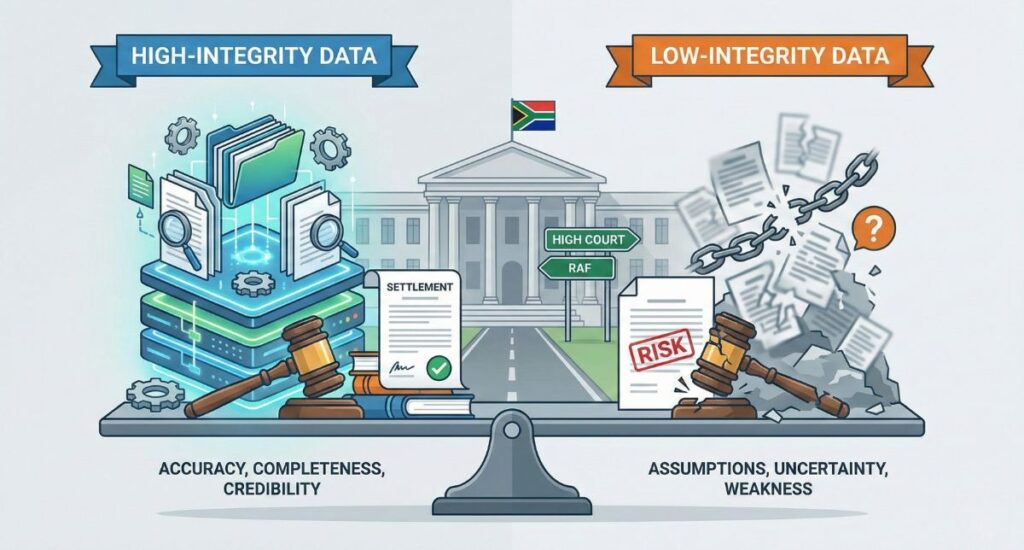
Litigation is ultimately a battle of evidence. Expert opinions, pleadings, medico-legal reports, and actuarial models all rely on the same underlying foundation: the quality of the data provided. In South African personal injury matters—especially those involving the Road Accident Fund or Gauteng Division of the High Court—the strength of a case often rises or falls on the accuracy, completeness, and credibility of the information attorneys place before their experts.
Many litigators focus on strategy, expert selection, and legal argument. Yet few recognise that the single most powerful lever in improving damages outcomes is the integrity of the data used to construct the case. High-integrity data shortens disputes, strengthens settlement positions, exposes weak opposing assumptions, and protects clients from unnecessary risk. Low-integrity data does the opposite.
This article explores why data quality is not just administrative housekeeping but a central driver of litigation performance.
Why Data Quality Shapes Case Value
Every stage of a personal injury matter depends on factual inputs. Industrial psychologists cannot form reliable vocational opinions without accurate pre- and post-accident histories. Medical experts cannot classify long-term disability without clear records. And actuaries cannot quantify damages when earnings records are incomplete, inconsistent, or outdated.
Poor-quality data forces experts to make assumptions where facts should exist. Every additional assumption becomes another opportunity for an opposing expert to challenge the model, undermine credibility, and reduce the damages value.
High-integrity data, by contrast, narrows the uncertainty. It removes the guesswork. It forces all experts—on both sides—to operate from the same factual baseline, tightening the range of possible outcomes and elevating the reliability of the entire litigation process.
The Domino Effect of Inaccurate Information
Even small gaps in data can create compounding distortions. A missing payslip can lead to an understated premorbid salary. A vague employment history can distort career progression modelling. Inaccurate age or qualification records may shift retirement assumptions or earning curves. And missing medical notes can weaken causation chains or understate functional impairment.
These distortions do not remain isolated; they cascade through the expert process:
Medical experts qualify their findings to reflect uncertainty.
Industrial psychologists widen their employment scenarios.
Actuaries must model several alternative outcomes.
Joint minutes become longer, looser, and harder to reconcile.
Opposing experts find more opportunities to challenge credibility.
By the time the matter reaches mediation or trial, the uncertainty has become structurally embedded in the case. All of this could have been mitigated earlier with disciplined data collection.

High-Integrity Data Makes Experts More Powerful
Experts are only as strong as the information they receive. A well-prepared brief with clean, consolidated, chronological records enables experts to give firm, defensible opinions. It allows actuaries to produce calculations that stand up under cross-examination and joint minute scrutiny. It strengthens the attorney’s negotiation position by presenting a coherent narrative supported by credible evidence.
On the other hand, experts who are forced to guess or assume inevitably issue qualified opinions. These qualifications become pressure points that opposing counsel exploit—often successfully.
When attorneys provide clean, accurate data, they give their experts the ability to be persuasive, authoritative, and aligned. This is particularly important when a matter involves multiple disciplines, each building on the findings of others.
How High-Quality Data Improves Damages Accuracy
Actuarial models are highly sensitive to input assumptions. A 10% misstatement in earnings can, over a projected working lifetime, translate into a multi-million-rand distortion in damages. Missing employment records can shift contingency arguments. Incorrect inflation adjustments or outdated salary benchmarks can materially alter settlement values.
High-integrity data ensures:
More accurate premorbid earnings
Better assessment of the claimant’s true economic trajectory
Stronger evidence for impaired post-accident employability
More defensible retirement, productivity, and inflation assumptions
Clearer differentiation between premorbid and postmorbid contingencies
It transforms the actuarial function from speculative modelling into precision quantification.
“Where facts meet precision, outcomes follow. At Vector Actuaries, we transform high-integrity data into defensible damages—ensuring your case is built on a foundation of certainty, not assumptions.”
Why Courts Favour Data-Driven Narratives
Judges in personal injury matters must distil complex expert evidence into practical findings. They are more likely to favour narratives supported by clear records than those reliant on speculation, memory, or inference. Where two experts disagree, courts often prefer the expert whose conclusions flow from verifiable, high-quality information.
High-integrity data also shortens trials. It reduces the scope for disputes. It ensures joint minutes converge more reliably. And it promotes settlements that genuinely reflect the claimant’s long-term losses.
In a system facing backlogs and delays, judges and mediators favour clarity anchored in facts rather than complexity driven by uncertainty.
Data Integrity Is a Strategic Advantage, Not an Administrative Task
For many firms, data gathering is treated as a logistical afterthought. In reality, it is one of the most strategic components of damages litigation. Firms that build disciplined data pipelines—early information capture, structured digital storage, checklists for earnings verification, and complete medical histories—consistently achieve better outcomes.
High-integrity data:
Strengthens negotiation leverage
Produces higher damages values where justified
Reduces exposure to criticism in joint minutes
Limits the need for revised reports
Supports faster settlements
Enhances the attorney’s professional reputation
It is not merely operational. It is a differentiator.
Final Thoughts
In litigation, facts matter, but high-integrity data transforms facts into power. It shortens disputes, strengthens expert testimony, clarifies damages models, and improves client outcomes. For attorneys operating in the RAF and medical negligence space, disciplined data management is no longer optional—it is a professional imperative.
The most successful litigators recognise that data quality is not just a supporting activity. It is a core pillar of strategy. When the information is strong, the experts are strong. When the experts are strong, the case becomes significantly harder to challenge.