
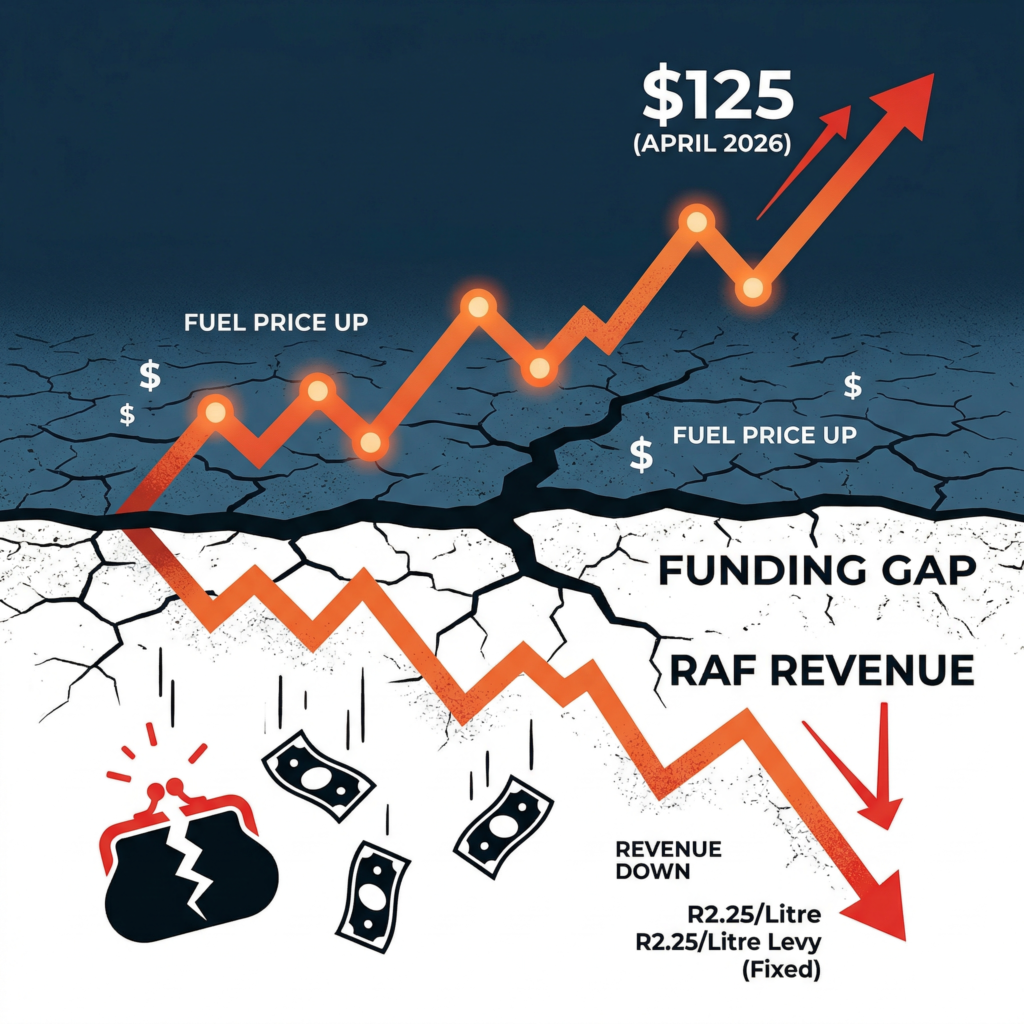
The escalation of the conflict in the Middle East has moved beyond a regional security concern to a systemic risk for South Africa’s fiscal stability. As Brent Crude remains volatile above $100 per barrel following the March 2026 closure of the Strait of Hormuz, the “price shock” is manifesting in a precarious way for the Road Accident Fund (RAF).
At Vector Actuaries, we believe that understanding the actuarial implications of this war requires looking past the pump price and into the structural integrity of the RAF’s funding model, and what that means for the legal profession.
Volumetric Decline & Revenue Squeeze
The RAF is funded by a fixed-rate levy, which as of April 2026, stands at R2.25 per litre. Unlike VAT, which scales with price, the RAF revenue is strictly tied to the volume of fuel sold.
Historically, South African petrol demand has proven price inelastic. This means that drivers do not reduce their kilometers traveled in equal proportion to price hikes. Most commuters have limited public transport alternatives, so they continue to drive despite higher costs.
However, the recent price shock may have pushed prices to a breaking point. When Brent Crude jumped quickly from $70 to $100 (and higher), South African 95 Unleaded rose by R3.00 per litre in a single month.
So what does this mean for RAF revenues?
Actuarial Calculation
If we assume a conservative price elasticity of demand of -0.15 (meaning a 10% price increase leads to a 1.5% drop in volume):
Price Increase: ~12% (from R24.50 to R27.50 average).
Projected Volume Drop: 12% x 0.15 = 1.8%
Fiscal Impact: On an annual fuel consumption of ~20 billion litres, a 1.8% drop represents 360 million litres lost.
Revenue Loss: 360,000,000 x R2.25 = R810 million in lost annual levy revenue.
Continued Liability Surge
While revenue is shrinking, the RAF’s liabilities are expanding.
The National Treasury’s 2026 Budget Review projected RAF liabilities to grow to R426.2 billion by 2028/29.
The Iran war exacerbates this through inflationary pressure on medical costs and loss-of-income claims.
This raises the question: is the RAF’s current model – funding a long-tail liability with a highly volatile, volume-based commodity tax – no longer viable in a world of geopolitical energy wars?

“Staycation” Silver Lining?
One potential offset is the reduction in road usage. If high fuel prices lead to a significant drop in “kilometers driven,” the frequency of accidents should, in theory, decrease.
This was most clearly seen in the reduced accident statistics reported during the COVID pandemic lockdowns.
However, Vector Actuaries notes a critical claim severity trend. While fewer cars may be on the road for leisure, the commercial and freight sectors (think taxis, busses and trucks), which is more prone to high-value, multi-vehicle accidents, remains active due to the lack of rail alternatives.
Thus, a 2% drop in road volumes does not necessarily equate to a 2% drop in claim values.
The Liquidity Crunch
For attorney firms specialising in personal injury, the geopolitical crisis in the Middle East translates directly into liquidity risk at home. As the RAF’s revenue stream from fuel sales undergoes this volumetric squeeze, firms can expect:
- Extended Payment Cycles: The “queue” for settled claims is likely to lengthen as the Fund prioritises operational survival over capital distribution.
- Aggressive Settlement Negotiations: Expect the Fund to push for lower settlements to preserve dwindling cash reserves.
- Operational Cash Flow Strain: For firms working on a contingency fee basis, the “volumetric squeeze” on the RAF revenue means the gap between successful litigation and actual fee recovery is widening. This increases the firm’s own cost of capital and requires more robust financial planning.
- Impact of Increased Interest Rates: To combat the inflation triggered by the oil shock, the SARB may maintain higher-for-longer interest rates.
- Risk of “Legislative Shortcuts”: Fiscal desperation often leads to talk of “no-fault” or “benefit-cap” legislation, or other restrictive legal regime changes, to curb the R426 billion liability.
Vector Actuaries provides the rigorous, court-ready quantum reports necessary to defend your clients’ claims against a cash-strapped Fund. Ensure your loss-of-income and actuarial calculations reflect the 2026 economic reality.
Contact Vector Actuaries today to secure the technical expertise your litigation strategy demands.