

The South African road accident compensation landscape is currently at a crossroads. For decades, the Road Accident Fund (RAF) has operated on a fault-based system, rooted in the principles of the Law of Delict. However, the recurring legislative push to replace the RAF with the Road Accident Benefit Scheme (RABS) threatens to fundamentally alter how victims are compensated and how their losses are quantified.
For the legal fraternity and actuarial experts alike, the shift from a “fault-based” to a “no-fault” model is more than merely a procedural change—it is a total reimagining of actuarial quantums.
The Fundamental Shift: Fault vs. No-Fault
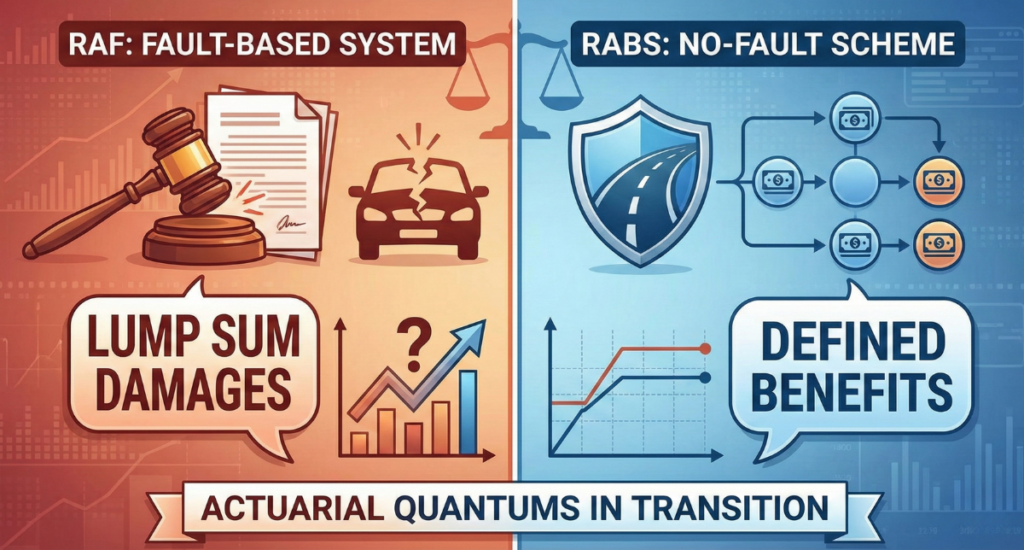
Under the current RAF model, a claimant must prove that the driver of the motor vehicle was negligent. Once negligence (even 1%) is established, the claimant is entitled to common law damages, which aim to place the victim in the position they would have been in had the accident not occurred.
RABS, in contrast, proposes a no-fault system. Compensation would be provided regardless of who caused the accident. While this is intended to broaden the safety net and reduce litigation costs, it necessitates a move away from “damages” toward “defined benefits.”
From Damages to Defined Benefits: The Actuarial Impact
In the current environment, an actuarial report is a calculation of a specific, individualized loss. It takes into account the claimant’s unique career trajectory, educational potential, and the nuanced application of pre- and post-morbid contingencies.
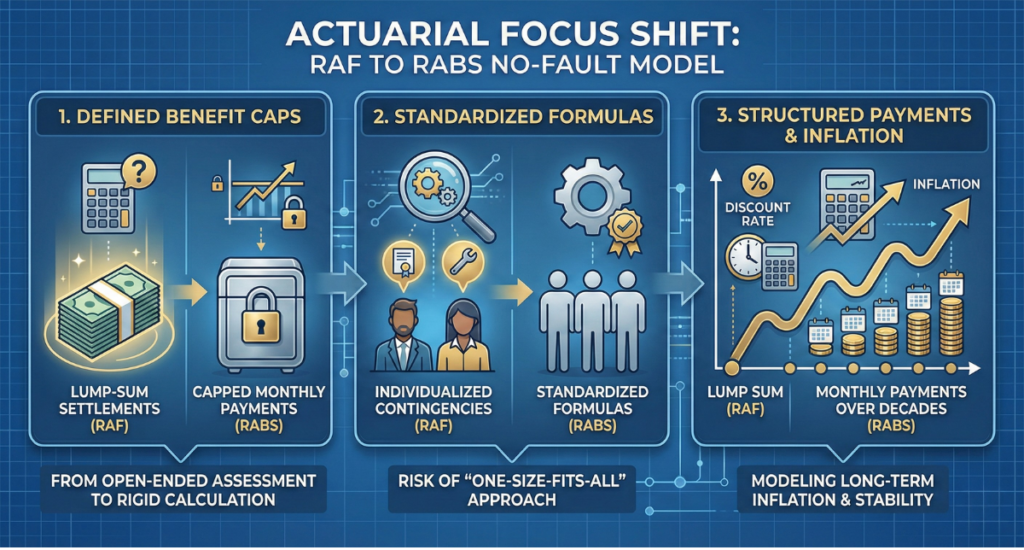
Under a no-fault RABS model, the actuarial focus shifts in three significant ways:
1. The Introduction of Defined Benefit Caps
RABS typically proposes structured, monthly payments rather than the lump-sum settlements common in RAF matters. These benefits are often capped at a specific income level. Actuarially, this changes the calculation from an open-ended assessment of “what might have been” to a rigid calculation of “what is permitted under the scheme.”
2. The Move Away from Individualized Contingencies
The current system allows for “judicial discretion” and the application of tailored contingencies to reflect the specific risks of a claimant’s life. A RABS model tends toward standardised formulas. This risks a “one-size-fits-all” approach that may fail to account for the high-achieving professional or the specialized artisan whose actual loss far exceeds the scheme’s defined caps.
3. Structured Payments and Inflationary Modeling
Calculating a lump sum requires a specific set of discount rates and life expectancy assumptions. In a RABS environment, where payments may be made monthly over several decades, the actuarial modeling must account for long-term inflation adjustments and the administrative stability of the benefit distributor.
The Constitutional Question: Right to Fair Compensation
The “revival” of RABS brings back the primary criticism leveled against it: the potential infringement of a victim’s right to seek full common law damages. If a victim is seriously injured by a negligent driver, a no-fault scheme that caps benefits at a lower level than their actual loss could be viewed as a dilution of their constitutional rights.
From an actuarial perspective, the “quantum gap”—the difference between what a victim is entitled to under common law and what they would receive under RABS—becomes the central point of contention.
Why Actuarial Certainty Remains Vital
Regardless of whether the system remains fault-based or shifts to a no-fault model, the need for authoritative, court-ready quantum reports remains.
If RABS is implemented, actuaries will be required to:
- Identify the “Quantum Gap” for potential constitutional challenges.
- Model long-term structured benefits to ensure they meet the minimum needs of the claimant.
- Provide expert testimony on the adequacy of the proposed benefits compared to actual economic loss.
“Regardless of whether the system remains fault-based or shifts to a no-fault model, the need for authoritative, court-ready quantum reports remains.“
Summary
The shift to a no-fault scheme represents the most significant change to South African personal injury law in a generation. While RABS aims to solve the administrative and financial crises of the RAF, it introduces a new layer of complexity in how we define “fairness” in financial terms.
As the legislative debate continues, the legal fraternity must remain vigilant. The transition from common law damages to defined benefits does not make the actuary’s role less important—it makes the precision of the calculation more critical than ever to ensure that justice is not sacrificed for the sake of administrative efficiency.