
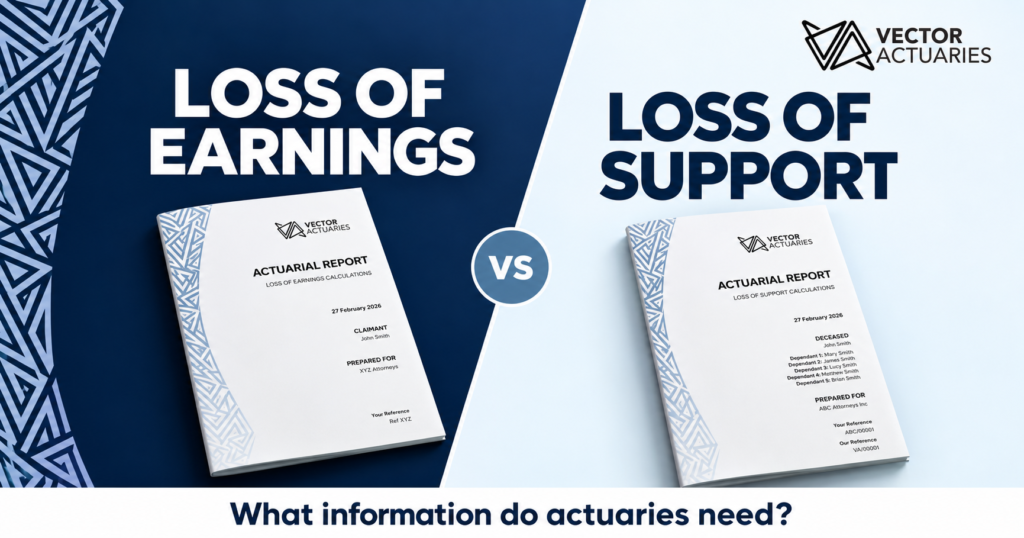
When preparing a Road Accident Fund (RAF) claim, gathering the correct information is one of the most important steps in ensuring an accurate actuarial calculation.
Although loss of earnings and loss of support claims both involve quantifying financial losses resulting from a road accident, the information required for each differs significantly.
For attorneys, understanding these differences can help streamline the actuarial process, reduce unnecessary queries and ensure that calculations are based on reliable evidence.
Understanding the Difference
Loss of Earnings (LOE)
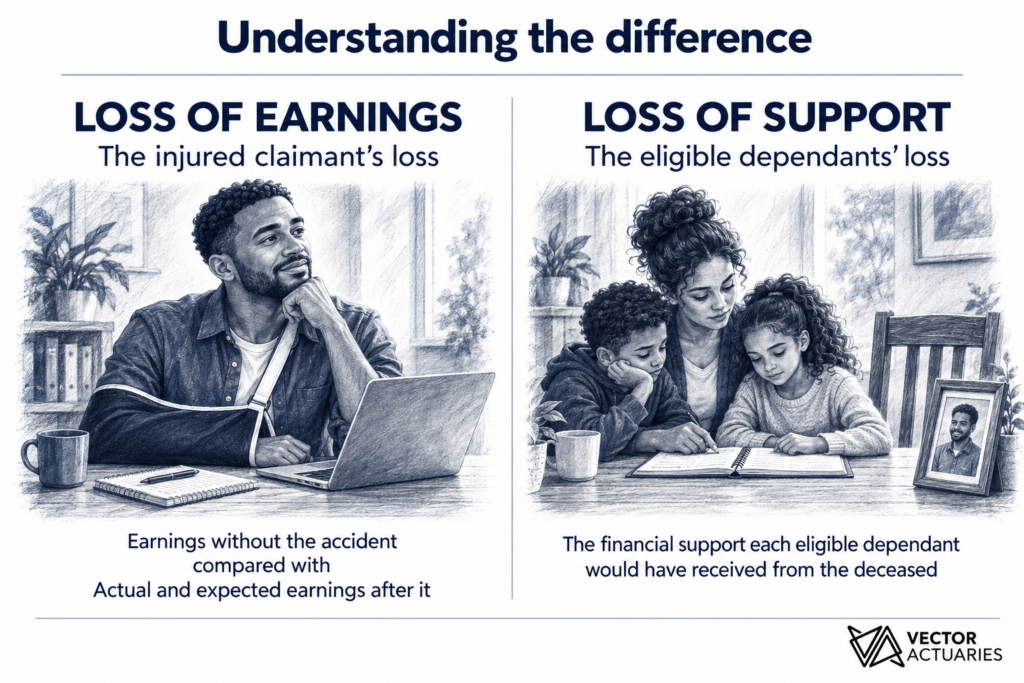
A loss of earnings claim arises when an individual sustains injuries in a motor vehicle accident that negatively affect their ability to earn an income.
The purpose of the actuarial calculation is to compare what the claimant would probably have earned had the accident not occurred with what they have earned, and are expected to earn, following the accident.
This includes both past and future financial losses.
Loss of Support (LOS)
A loss of support claim arises when an individual dies as a result of a motor vehicle accident, leaving behind people who had a legally recognised right to financial support from the deceased.
These dependants may include a spouse, children or, in certain circumstances, other family members or partners.
Unlike a loss of earnings calculation, which focuses on the injured individual’s financial position, a loss of support calculation focuses on the financial support that eligible dependants have lost as a result of the death.
Loss of Earnings: What Information Is Needed?
An accurate loss of earnings calculation requires a clear understanding of the claimant’s financial position before and after the accident.
Employment and Income Information
The claimant’s employment history and earnings are essential in establishing their pre-accident financial position.
Useful documentation includes:
- Payslips from before and after the accident.
- Employment contracts and employer confirmation letters.
- IRP5 certificates and relevant SARS income tax records.
- Evidence of bonuses, overtime, commissions and allowances.
- Details of employer pension, medical aid and other employment benefits.
- Employment commencement and termination dates, where applicable.
Where a claimant is self-employed, business financial statements, tax returns, bank statements and other reliable records of business income and expenditure may be required.
An important distinction is that business turnover does not necessarily represent the claimant’s personal earnings.
Post-Accident Earnings and Employment Changes
The claimant’s income following the accident is equally important.
Attorneys should provide information relating to any changes in employment, salary reductions, periods of unemployment or other financial consequences of the injuries.
For example, if the claimant was unable to work for six months following the accident, the actuary needs to establish whether the claimant received their full salary, a reduced salary or no remuneration during that period.
Documentation confirming sick leave, unpaid leave, termination of employment, medical boarding or redeployment can therefore be particularly valuable.
Expert Reports
The industrial psychologist’s report frequently forms the foundation of a loss of earnings calculation.
It typically provides the assumptions regarding the claimant’s probable career progression, earnings and retirement age, both before and after the accident.
These assumptions are often informed by medical and vocational evidence, including reports from occupational therapists and other relevant medical specialists.
The actuary uses the available evidence and expert assumptions to quantify the financial consequences of the claimant’s reduced earning capacity.
What About Claimants Who Were Not Employed?
A claimant does not necessarily need to have been earning an income at the time of the accident to have a potential claim for future loss of earning capacity.
For example, a school learner or university student may have suffered injuries that affect their future education and career opportunities.
In these cases, educational records, academic performance, qualifications, family circumstances and expert assessments may assist in developing reasonable future earnings assumptions.
The absence of historical earnings does, however, introduce additional uncertainty, making the supporting evidence particularly important.
Preparing a loss of earnings claim?
Use our one-page attorney checklist to gather the claimant’s employment history, earnings records and relevant expert reports. Mark what you have, what you still need and what does not apply, with space to record missing information, assumptions or special instructions.
Loss of Support: What Information Is Needed?
A loss of support calculation involves a different set of considerations.
The calculation must establish the deceased individual’s probable financial contribution to eligible dependants had the death not occurred.
This requires information about both the deceased and the people who depended on their support.
Information Relating to the Deceased
The following information is particularly useful:
- The deceased’s full name, identity number and date of birth.
- Date of the accident and date of death.
- Death certificate.
- Employment history and earnings documentation.
- Pension and other employment benefits, where relevant.
- Relevant educational qualifications and career progression assumptions.
Is an Industrial Psychologist’s Report Necessary for Loss of Support?
Unlike a loss of earnings claim, an industrial psychologist’s report is not generally required to prepare a loss of support calculation. However, obtaining one may be beneficial and could potentially result in a higher quantified claim.
In the absence of an industrial psychologist’s report, an actuary may project the deceased’s future earnings using the available income records, employment information and appropriate assumptions regarding future increases.
However, this approach may not fully account for the deceased’s potential career progression.
For example, an industrial psychologist may establish, based on the deceased’s qualifications, experience and employment history, that the deceased would probably have received promotions, progressed to a higher occupational level or achieved a substantially higher income before retirement.
Where these higher future earnings are reasonably supported by the evidence, incorporating them into the actuarial calculation may increase the projected financial support that the deceased would have provided to their dependants.
Consequently, the resulting loss of support calculation could be higher than one based primarily on the deceased’s historical earnings and inflation-related increases.
This is particularly relevant where the deceased was young, had recently entered the workforce or had identifiable opportunities for career advancement.
It is important to recognise that an industrial psychologist’s report does not guarantee a higher claim. Any proposed career progression must be reasonable, supported by evidence and appropriate to the deceased’s individual circumstances.
For attorneys, the key consideration is that although an industrial psychologist’s report may not be necessary to quantify a loss of support claim, it can provide valuable evidence of the deceased’s future earning potential and help ensure that the full extent of the dependants’ financial loss is properly considered.
Information Relating to the Dependants
One of the most important differences between the two types of claims is that loss of support calculations require detailed information about each eligible dependant.
This includes the dependant’s full name, date of birth, relationship to the deceased and the basis on which they received or were legally entitled to support.
Documents such as marriage certificates, unabridged birth certificates, maintenance orders and evidence of financial dependency may be relevant.
A marriage certificate is not the only possible means of establishing a legally recognised duty of support. Certain unmarried partners and other dependants may also qualify, depending on their circumstances and the applicable law.
Where children are involved, their dates of birth and educational circumstances are particularly important, as these may influence the expected duration of support.
Support does not necessarily end automatically when a child turns 18. The relevant circumstances, including continued education and financial dependency, must be considered.
The Surviving Spouse’s Income
Another significant consideration is the surviving spouse’s earnings.
Where applicable, the actuary may require details of the surviving spouse’s current income and expected future earnings.
This information is important because the calculation considers the financial support available within the household and how that support would have been allocated between family members.
The objective is to determine the financial support each eligible dependant has lost, rather than simply treating the deceased’s full salary as the loss.
Other Financial Support and Benefits
Additional information may be required where the deceased had maintenance obligations, supported dependants outside the immediate household or contributed to more than one household.
Relevant pension benefits, compensation awards, insurance arrangements and other financial benefits should also be disclosed for consideration.
However, the existence of such a benefit does not automatically mean that it should be deducted from the loss of support calculation. Its treatment depends on its nature and the applicable legal principles.
Preparing a loss of support claim?
Use our one-page attorney checklist to organise the deceased’s earnings information, dependant details and supporting financial records. It also covers household income, dependency periods and relevant benefits, helping you identify outstanding information and communicate clear instructions to the actuary.
Why Does Complete Information Matter?
Missing information does not necessarily prevent an actuarial calculation from being prepared. However, it can introduce uncertainty and require additional assumptions.
Consider a loss of earnings claim where the industrial psychologist confirms that the claimant returned to work after the accident, but no post-accident payslips are available.
Without reliable evidence of the claimant’s actual earnings, it may be difficult to establish the extent of the past financial loss.
Similarly, in a loss of support matter, missing information about a surviving spouse’s earnings or the existence of other dependants may affect how the deceased’s projected support is allocated.
Incomplete records may lead to additional queries, alternative calculations or subsequent report amendments when new information becomes available.
The earlier relevant documents are obtained, the easier it becomes to establish clear and consistent calculation assumptions.
The Importance of Collaboration Between Attorneys and Actuaries
An effective actuarial calculation depends on more than mathematical accuracy.
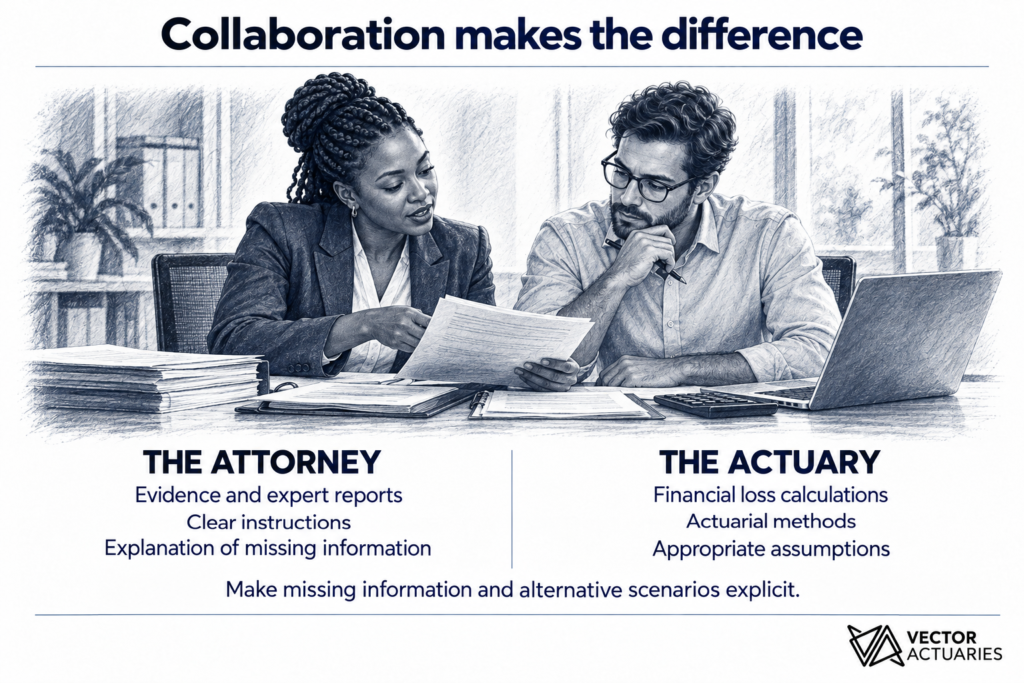
Attorneys play a crucial role in collecting the available evidence, obtaining expert opinions and communicating the circumstances of the claim.
The actuary then uses this information to quantify the financial loss, applying appropriate actuarial methods and assumptions.
Where information is unavailable, it is helpful for attorneys to explain the circumstances rather than leaving the actuary uncertain about whether the information exists.
Clear instructions are particularly important where there are multiple earnings scenarios, disputed facts, outstanding expert opinions or specific assumptions that the attorney wishes to have quantified.
It is also important to distinguish between information needed to lodge a claim with the RAF and evidence needed to substantiate the amount of compensation claimed. Not every document useful for an actuarial calculation is necessarily a statutory requirement for valid lodgement.
Getting It Right From the Beginning
Although loss of earnings and loss of support claims share similarities, the information required to quantify each loss is fundamentally different.
A loss of earnings calculation focuses on the injured claimant’s employment prospects and financial position before and after the accident.
A loss of support calculation focuses on the deceased’s potential financial contribution and the support lost by each eligible dependant.
While an industrial psychologist’s report is often central to determining loss of earning capacity, its potential value in loss of support matters should not be overlooked, particularly where future career progression could materially influence the calculated loss.
For attorneys, identifying these requirements early can help prevent unnecessary delays, minimise repeated requests for information and support a more efficient claims process.
At Vector Actuaries, we recognise the importance of working closely with attorneys to ensure that actuarial calculations are based on clear instructions, reliable information and appropriate assumptions.
Ultimately, accurate financial quantification begins with the quality of the information provided.